
Email: info@shhejochemicals.com
Phone: + 86 21 6417 1223 / +86 152 167 18324
Address: 910. 9th Floor, No.99 South Longshui Road, Xuhui District, Shanghai, China 200232
Product Overview
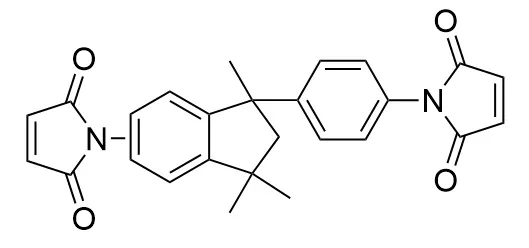
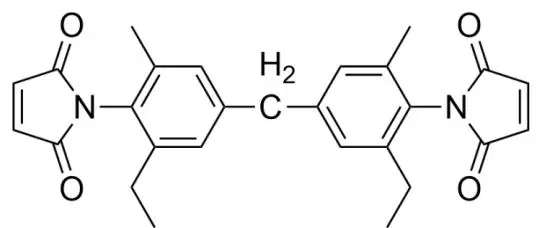
BPM (Bismaleimide Monomer with Indane Structure) is a high-performance specialty thermosetting resin monomer engineered for next-generation 5G/6G high-frequency, high-speed copper-clad laminates (CCL), advanced electronic packaging, and aerospace structural composites. By integrating a rigid, bulky, and non-coplanar phenylindane skeleton into the bismaleimide backbone, BPM effectively disrupts molecular symmetry—dramatically enhancing solubility and reducing dielectric loss while preserving exceptional high-temperature resistance and mechanical rigidity.
Typical Physical & Chemical Properties
|
Property |
Specification / Typical Value |
Test Method / Conditions |
|
Appearance |
Light yellow to brownish fine powder |
Visual Inspection |
|
Melting / Softening Point |
180 °C ~ 230 °C |
DSC / Capillary Method |
|
Purity (Assay) |
≥ 98.5% |
HPLC |
|
Volatiles |
≤ 0.5% |
105 °C × 2 h |
|
Ionic Impurities (Cl⁻) |
≤ 10 ppm |
Ion Chromatography (IC) |
|
Ionic Impurities (Na⁺, K⁺) |
≤ 5 ppm (each) |
ICP-OES |
|
Solution Clarity (50 wt% in MEK) |
Clear, transparent, particle-free |
Visual / 0.45 μm filtration |
Cured Resin Performance (Typical Reference)
Note: Data obtained from a standard thermal-cured system (BPM co-cured with reactive modifiers).
|
Property |
Typical Value |
Test Method |
|
Dielectric Constant (Dₖ) |
2.7 ~ 3.0 (1 GHz ~ 10 GHz) |
IPC-TM-650 2.5.5.9 |
|
Dielectric Loss Factor (D_f) |
0.003 ~ 0.007 (1 GHz ~ 10 GHz) |
IPC-TM-650 2.5.5.9 |
|
Glass Transition Temp. (T_g, DMA) |
280 °C ~ 350 °C |
ASTM D7028 |
|
Thermal Decomposition (T_d5%) |
> 410 °C (in N₂) |
TGA |
|
Water Absorption (24h, boiling) |
≤ 0.3% |
ASTM D570 |
Key Advantages & Processing Benefits
· Ultra-Low Signal Distortion: Bulky indane rings increase free volume and lower polarizability, ensuring exceptional Dₖ/D_f stability across gigahertz frequencies.
· Superior Solvent Compatibility: Readily soluble in eco-friendly and standard electronics solvents (e.g., MEK, Acetone, Cyclohexanone, NMP), enabling stable, high-solid-content varnish formulations without crystal precipitation.
· Excellent Co-curability: Exhibits broad processing windows and excellent compatibility with allyl compounds (such as DABPA), epoxy resins, and cyanate esters for interpenetrating polymer network (IPN) modifications.
· Strict Electronic Grade Control: Minimized ionic residues (Cl⁻, Na⁺) to prevent ion migration and ensure long-term PCB reliability.
Recommended Applications
· 5G/6G High-Frequency, Low-Loss CCL & Multi-Layer PCBs
· High-Temperature Insulating Varnishes & Electronic Packaging Adhesives
· Advanced Aerospace Heat-Resistant Composite Matrices
Packaging, Handling & Storage
· Packaging: 20 kg / 25 kg fiber drum lined with moisture-proof polyethylene bag.
· Storage: Store tightly sealed in a cool, dry, dark, and well-ventilated area away from direct sunlight, heat sources, and moisture.
· Shelf Life: 12 months from the date of manufacture.
Product Overview
BPM (Bismaleimide Monomer with Indane Structure) is a high-performance specialty thermosetting resin monomer engineered for next-generation 5G/6G high-frequency, high-speed copper-clad laminates (CCL), advanced electronic packaging, and aerospace structural composites. By integrating a rigid, bulky, and non-coplanar phenylindane skeleton into the bismaleimide backbone, BPM effectively disrupts molecular symmetry—dramatically enhancing solubility and reducing dielectric loss while preserving exceptional high-temperature resistance and mechanical rigidity.
Typical Physical & Chemical Properties
|
Property |
Specification / Typical Value |
Test Method / Conditions |
|
Appearance |
Light yellow to brownish fine powder |
Visual Inspection |
|
Melting / Softening Point |
180 °C ~ 230 °C |
DSC / Capillary Method |
|
Purity (Assay) |
≥ 98.5% |
HPLC |
|
Volatiles |
≤ 0.5% |
105 °C × 2 h |
|
Ionic Impurities (Cl⁻) |
≤ 10 ppm |
Ion Chromatography (IC) |
|
Ionic Impurities (Na⁺, K⁺) |
≤ 5 ppm (each) |
ICP-OES |
|
Solution Clarity (50 wt% in MEK) |
Clear, transparent, particle-free |
Visual / 0.45 μm filtration |
Cured Resin Performance (Typical Reference)
Note: Data obtained from a standard thermal-cured system (BPM co-cured with reactive modifiers).
|
Property |
Typical Value |
Test Method |
|
Dielectric Constant (Dₖ) |
2.7 ~ 3.0 (1 GHz ~ 10 GHz) |
IPC-TM-650 2.5.5.9 |
|
Dielectric Loss Factor (D_f) |
0.003 ~ 0.007 (1 GHz ~ 10 GHz) |
IPC-TM-650 2.5.5.9 |
|
Glass Transition Temp. (T_g, DMA) |
280 °C ~ 350 °C |
ASTM D7028 |
|
Thermal Decomposition (T_d5%) |
> 410 °C (in N₂) |
TGA |
|
Water Absorption (24h, boiling) |
≤ 0.3% |
ASTM D570 |
Key Advantages & Processing Benefits
· Ultra-Low Signal Distortion: Bulky indane rings increase free volume and lower polarizability, ensuring exceptional Dₖ/D_f stability across gigahertz frequencies.
· Superior Solvent Compatibility: Readily soluble in eco-friendly and standard electronics solvents (e.g., MEK, Acetone, Cyclohexanone, NMP), enabling stable, high-solid-content varnish formulations without crystal precipitation.
· Excellent Co-curability: Exhibits broad processing windows and excellent compatibility with allyl compounds (such as DABPA), epoxy resins, and cyanate esters for interpenetrating polymer network (IPN) modifications.
· Strict Electronic Grade Control: Minimized ionic residues (Cl⁻, Na⁺) to prevent ion migration and ensure long-term PCB reliability.
Recommended Applications
· 5G/6G High-Frequency, Low-Loss CCL & Multi-Layer PCBs
· High-Temperature Insulating Varnishes & Electronic Packaging Adhesives
· Advanced Aerospace Heat-Resistant Composite Matrices
Packaging, Handling & Storage
· Packaging: 20 kg / 25 kg fiber drum lined with moisture-proof polyethylene bag.
· Storage: Store tightly sealed in a cool, dry, dark, and well-ventilated area away from direct sunlight, heat sources, and moisture.
· Shelf Life: 12 months from the date of manufacture.
Email: info@shhejochemicals.com
Phone: + 86 21 6417 1223 / +86 152 167 18324
Address: 910. 9th Floor, No.99 South Longshui Road, Xuhui District, Shanghai, China 200232
Copyright © 2025 Shanghai Hejo Chemicals Ltd. Powered by iglobalwin.com